
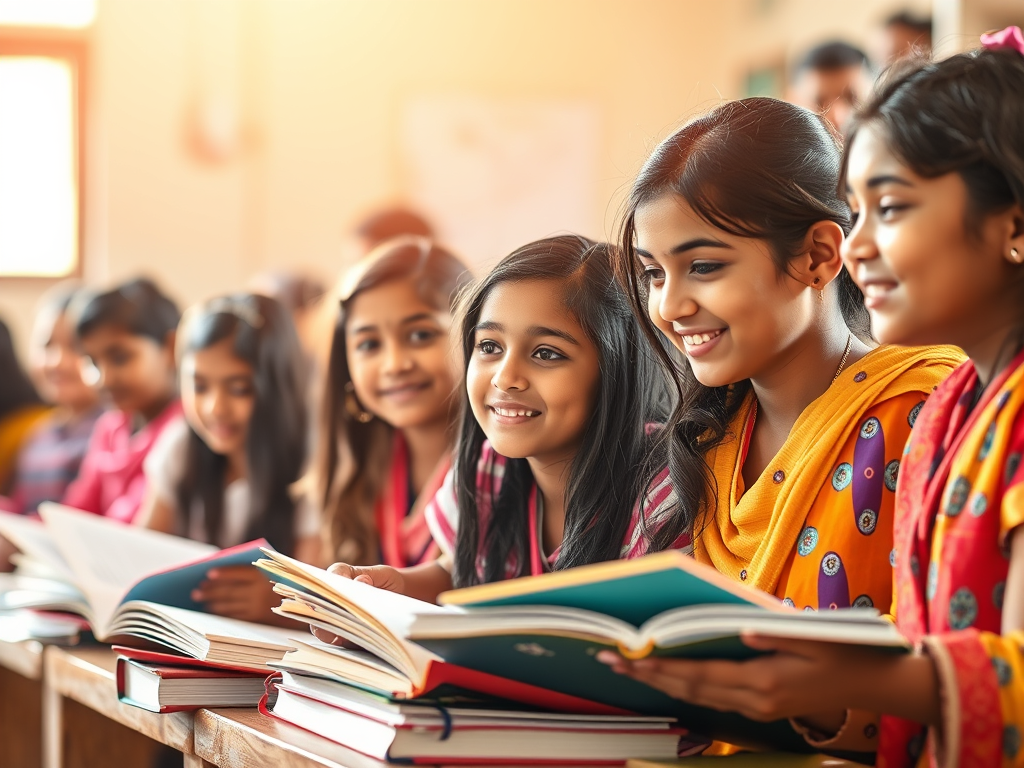
Advancing gender equality through education has been a cornerstone of India’s social and economic reform agenda. The Government of India over the years has implemented a series of scholarships and incentive programs to enhance girls’ participation in education, bridge systemic inequalities, reduce dropout rates, and strengthen the role of education as a tool for empowerment. These initiatives provide vital financial support at every educational level, ensuring that girls across rural and urban India can pursue continuous learning and achieve economic independence.
By Purvi Gupta
Scholarships and Incentive Programs for Girls
The government has introduced several flagship schemes to promote girls’ education and empowerment. These programs extend from early childhood to higher education and skill development, offering both direct financial aid and institutional support.
- Pragati Scholarship Scheme for Girl Students – Encourages meritorious girls to pursue technical education in fields such as engineering and pharmacy, offering ₹50,000 per year for the course duration.
- Post Graduate Indira Gandhi Scholarship for Single Girl Child – Supports postgraduate education for the only girl child in a family, with ₹36,200 per annum for two years.
- Balika Samridhi Yojana (BSY) – Provides annual financial assistance to school-going girls from Below Poverty Line families to encourage sustained schooling.
- Mahila Samman Savings Certificate (MSSC) – A small savings initiative allowing deposits up to ₹2 lakh for two years, offering financial security to women and girls.
- National Scheme of Incentives to Girls for Secondary Education (NSIGSE) – Addresses dropout rates by depositing ₹3,000 in the name of eligible girls from disadvantaged backgrounds.
- CBSE Merit Scholarship Scheme for Single Girl Child – Awards scholarships to single girl students with over 60% marks in Class 10, continuing studies in Classes 11 and 12.
- Support to Training and Employment Programme for Women (STEP) – Focuses on skill development and employment training for women across multiple sectors.
- Beti Bachao Beti Padhao (BBBP) – Promotes awareness on girls’ education, tackles declining child sex ratios, and supports survival, protection, and learning opportunities for girls.
These multi-dimensional programs have significantly improved girls’ enrolment and health outcomes. The national sex ratio at birth improved from 918 in 2014–15 to 930 in 2023–24, reflecting growing societal awareness and acceptance of the girl child.
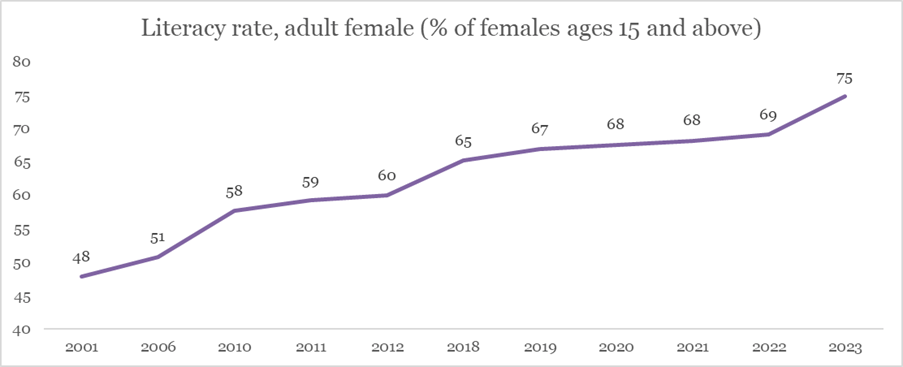
The adult female literacy rate (ages 15+) climbed steadily from around 47.8% in 2001 to nearly 74.8% by 2023. This consistent long-term rise confirms a profound, cumulative improvement in foundational educational attainment for women across the adult population.

The trend for school enrolment also shows a successful upward pipeline of educated girls. Primary enrolment is consistently high, indicating near-universal access. econdary enrolment shows strong, steady growth, nearly doubling in the period. Tertiary enrolment exhibits the sharpest increase, demonstrating a rapid and significant expansion of women’s access to higher education.
The following outlines the scholarship and incentive programs by the Government of India designed to promote gender equality and increase the educational participation of women and girls:
The Right to Education (RTE) Act
The Right to Education (RTE) or Right To Free And Compulsory Education, enacted in 2009 under Article 21A, guarantees free and compulsory education to every child aged 6–14. It enforces standardised norms for school infrastructure, ensures non-discriminatory admission, prohibits expulsions, and mandates facilities like drinking water, toilets, and playgrounds.
Key provisions of the RTE include:
- Free and compulsory education for every child.
- Out-of-school children to be admitted to an age-appropriate class and complete elementary education
- Establishes norms and standards for pupil-teacher ratios, buildings, infrastructure, and school operating days.
- Prohibits the denial of admission or expulsion of a child during elementary education.
- Requires no interview for admission and provides special training for dropouts.
- Mandates facilities like drinking water, separate toilets, and playgrounds.
- Requirement for every school, including privately-run ones, to give immediate free education to students from socially and economically backward classes from class I till they reach the age of 14 years.
By requiring both public and private schools to reserve seats for children from economically weaker sections, the RTE has played a pivotal role in bridging gender and social gaps. Between 2007–08 and 2012–13, girls accounted for 56% of new elementary-level enrolments, particularly in states like Rajasthan, Uttar Pradesh, and Bihar. The Act has also been associated with a measurable decline in child marriage rates, underscoring its social impact.
Beti Bachao, Beti Padhao (BBBP)
Launched in 2015, BBBP addresses gender-biased sex selection and promotes girls’ survival, education, and welfare. It was launched to address the declining child sex ratio, which had dropped from 927 girls per 1,000 boys in 2001 to 918 in 2011, through awareness campaigns and improved welfare services for girls. Its key goals include preventing discrimination before birth, ensuring safety and retention in schools, improving access to welfare schemes, and encouraging participation in education and sports.
Key provisions of the program include:
- Prevent gender-biased sex selection: It aims to combat the deep-rooted patriarchal mindset that leads to discrimination against girls, including gender-biased sex-selective abortions.
- Ensure survival and protection of the girl child: The scheme promotes the right of girls to be born and ensures their safety.
- Universal enrolment: The campaign seeks to increase the enrolment and retention of girls in schools at all levels.
- Improve welfare services: It works to improve the delivery and effectiveness of welfare services for girls, including educational support.
- Promote participation: BBBP strives to empower girls to participate fully in all spheres of life, including education, sports, and other activities.
The program has achieved significant success in raising public awareness about gender discrimination and the importance of valuing girls – contributing to increased sex ratio at birth. It has driven progress in raising girls’ school enrolment and access to maternal healthcare. The gross enrolment ratio(GER) of girls at secondary level has increased to 80.29% in the financial year 2016-17 against 80.10% in year 2015-16. However, challenges remain in equitable state-level implementation and ensuring that funds are directed toward education and healthcare rather than solely on publicity.
Sukanya Samriddhi Yojana (SSY)
Introduced as part of the BBBP campaign, SSY encourages long-term savings for the education and marriage of girl children. Families can invest up to ₹1.5 lakh annually with tax benefits, and the account matures after 21 years or upon the girl’s marriage post-18. Up to 50% of the corpus can be withdrawn for higher education.
Key provisions of the program include:
- Eligibility: A girl child aged 10 years or below can have an account opened in her name by a parent or legal guardian. A family can open upto two accounts, or three in the case of twins.
- Deposits: You can deposit a minimum of ₹250 and a maximum of ₹1.5 lakh in a financial year.
- Duration: The account can be operated for 21 years from the date of opening or until the girl child’s marriage after she turns 18.
- Withdrawals: Up to 50% of the account balance can be withdrawn for the higher education of the girl child after she turns 18.
- Interest: The interest is compounded annually and is tax-free under Section 10 of the Income Tax Act.
- Tax benefits: Deposits are eligible for a tax deduction under Section 80C of the Income Tax Act.
By incentivizing structured savings, the scheme promotes financial security for girls and reduces the likelihood of early marriages or school dropouts. Fundamental aim of this scheme is to promote financial security for their education and marriage, empower them economically, and contribute to gender equality. It has also boosted awareness and social progress by creating a strong message about investing in the future of girls.
National Education Policy (NEP) 2020
India’s NEP 2020 marks a transformative shift toward an inclusive, flexible, and skills-oriented education system. It replaces the 1986 policy and introduces a 5+3+3+4 pedagogical structure, vocational training from grade 6, flexible subject choices, and competency-based assessments.
Other key provisions of the policy include:
- Focus on foundational literacy and numeracy (FLN): All children achieve basic reading, writing, and arithmetic skills by Grade 3 through the National Mission on Foundational Literacy and Numeracy.
- Flexibility in subject choice: Students can choose subjects across arts, sciences, and commerce based on their interests.
- Vocational education from Grade 6: To develop practical skills, vocational training, including internships, is introduced early in schooling. This aims to expose at least 50% of learners to vocational education by 2025.
- Multidisciplinary higher education: It promotes a broad-based, flexible undergraduate curriculum with multiple entry and exit options.
- Assessment reforms: This policy shifts toward regular, competency-based assessment that promotes learning and critical thinking. It introduces the National Assessment Centre (PARAKH) to set standard guidelines.
For girls, the NEP emphasizes the Gender Inclusion Fund, gender-sensitive curricula, and improved physical infrastructure, including hostels and sanitation facilities. Teacher training on gender equity and financial support through scholarships aim to enhance retention and participation at all levels. The policy also includes provisions for teacher training on gender sensitivity, skill development for diverse careers, and other support measures like Conditional Cash Transfers to tackle dropout rates and societal barriers.
Kasturba Gandhi Balika Vidyalaya (KGBV)
Since 2004, the KGBV scheme has provided residential schooling for girls from marginalised communities in educationally backward blocks. Students receive free education, accommodation, meals, learning resources, and life-skills training. The program’s comprehensive environment nurtures both academic and personal development while addressing safety and inclusion.
Key provisions of the scheme include:
- Establishment of residential schools in educationally backward blocks which includes free boarding and lodging for girls aged 10 to 18.
- Students receive free uniforms, textbooks, and school supplies. Toiletries and sanitary pads are also provided.
- Infrastructure amenities like well-maintained buildings, beds, kitchen and dining areas, safe drinking water, toilets, and CCTV cameras.
- This scheme provides academic assistance, learning materials, library and equipment.
- Focus on the overall development of the students. Beyond academics, life skills training, vocational skills, physical education, and extracurricular activities are also taught.
- Special support for disabled girls by giving them a stipend of ₹200 per month for ten months is provided to encourage attendance and assistance of ₹3,500 per year is also provided per child with special needs.
KGBVs have significantly improved access for underprivileged girls and remain crucial to closing socio-economic and gender gaps in education . As a result of its all-inclusive strategy, including extracurricular activities, vocational training and residential schooling. KGBVs serve as both caring settings and learning centers that promote holistic development.
Udaan: Giving Wings to Girl Students
Launched in 2014, this Ministry of Education initiative supports meritorious girls from disadvantaged groups preparing for engineering and technical colleges. It provides free online coaching materials, mentorship, assessments, and, in some cases, tablets or financial aid.
Key provisions of the scheme include:
- Free resources – The scheme offers free online and offline learning materials, including study materials, video tutorials, and interactive video lessons for Physics, Chemistry, and Mathematics (PCM) for Classes XI and XII.
- Mentoring: Meritorious students receive peer-learning and mentoring opportunities.
- Assessment and feedback: Regular assessments and feedback are provided to continuously track and monitor the students’ progress.
- Help-line services: A student helpline is available to clarify doubts and provide technical support.
- JEE preparation: The scheme helps prepare girls for engineering entrance exams like JEE Main and Advanced, bridging the gap between school education and the entrance tests.
- Technological assistance: In some cases, selected students may be provided with a pre-loaded tablet or financial assistance to purchase one.
Udaan has opened pathways for girls into STEM disciplines, reducing gender imbalance in premier STEM institutions like IITs and NITs. It also serves as a motivational model, inspiring young women to pursue higher education and professional careers. Beyond academic support, the scheme offers mentoring and motivation sessions that help build students’ confidence and broader career aspirations, which, in some cases, has also helped prevent child marriages. This educational empowerment provides financial relief to families and creates a ripple effect, inspiring other girls and promoting the value of girls’ higher education within communities
In conclusion, India’s gender-focused education schemes have embodied a multi-layered approach—spanning financial incentives, legal rights, skill-building, and mentorship. Together, they have helped narrow the gender gap in education, encouraged STEM participation, improved health outcomes, and fostered independence among young women. Sustaining this momentum will require consistent monitoring, adequate funding, and stronger gender mainstreaming across all education policies, ensuring that every girl in India not only learns, but thrives.
 Ellenomics