

Shravani Prakash
At some point in human history, the rules were made — men would be the breadwinners, venturing into the world of paid work, while women would stay home to care for the household and family. This seemingly simple division of roles had far-reaching consequences. It not only placed the burden of unpaid care work disproportionately on women, but it also shaped the very design of our workplaces, institutions, cities, and technologies — largely by men, for men.
The legacy of this gendered history echoed throughout the world of work and people’s lifestyles:
- Workplaces, policies, and economic models were built on masculine norms, valuing competition over collaboration, and linear career trajectories over flexible ones
- Occupational segregation was entrenched early on, with rigid definitions of “men’s work” and “women’s work,” leading to limited access to education, skills, and opportunities for women.
- Products and services were, and often still are, designed primarily with male consumers in mind.
- Public infrastructure and urban design, from transport systems to sanitation facilities, ignored women’s specific needs and safety.
- Policy frameworks, developed by predominantly male policymakers, were deemed “gender-neutral” but ended up being gender-blind, failing to account for different impacts on women and men.
- Economic data collection rarely included gender-disaggregated data, making the economic contributions and realities of women invisible.
- Digital and technological tools, often built on biased datasets, are now mirroring and even amplifying these existing inequalities in the emerging digital economy.

Let us take a closer look at the gender-biased history of work and labour trends — and what we can learn from it to shape a more inclusive future.
Agriculture –one of the first vocations in history – has been male-oriented
- The physically demanding nature of the use of the plough religated farming as men’s work.
- Women’s agricultural contributions were invisible in policy, statistics, and support programmes.
- Government schemes for training, credit, inputs, and technology were designed with male farmers as targets.
- Patrilineal inheritance and male ownership norms limited women’s asset ownership and resource access.
- Women were excluded from leadership roles in farming organisations, limiting their influence.
- In today’s times, the digital divide mirrors the biases and restricts women’s access to advisory services, markets, and innovations.
Workplaces built by men embedded male-centric norms into their very structures, policies, and infrastructure.
- One of the earliest and most glaring oversights was the absence of female restrooms in offices, factories, and even legislative buildings, since “women were not expected, or welcome, in those spaces”.
- Not surprisingly, workplaces did not include private lactation spaces or crèche facilities.
- Tools, uniforms, personal protective equipment (PPE), and office furniture were traditionally designed to fit the average male body.
- Even Office air conditioning standards were historically based on the metabolic rates of a 40-year-old, 70-kg man, which is why most office spaces are calibrated to temperatures that are uncomfortably cold for most women
- Inadequate parental leave policies, and limited access to affordable childcare are not accidental. They reflect a system built on the assumption that men are the primary earners and women the caregivers.
- Workplaces rewarded “face time”, valuing long hours and constant physical presence in the office as a key marker of commitment and performance. Since men were not supposed to have caregiving duties, the need for flexible working arrangements was never considered.
- Job advertisements and recruitment channels have reflected implicit gender biases. Language commonly used in job descriptions — such as “strong,” “decisive,” or “expert” — tends to appeal more to male candidates and deter female applicants.
- AI is now replicating these biases. AI hiring tools are often trained on historical hiring data, which reflects a world where men were more likely to be hired, promoted, or deemed suitable for a leadership role. If a company’s past top performers were predominantly male, AI systems may learn to associate “success” with male characteristics, penalizing women applicants even when equally qualified.
Men at work designed products and services for the ‘default’ male user — women were an afterthought, if at all.
Many products and services have been designed around the default male user, ignoring female physiology, behaviour, and functional needs. The term “shrink it and pink it” describes making male-designed products smaller and colouring them pink to target women, without meaningful redesign for female users. This superficial approach can be insulting, unsafe and inconvenient for women:
- Women are 73% more likely to be injured in car crashes because safety features are designed using male-sized crash test dummies.
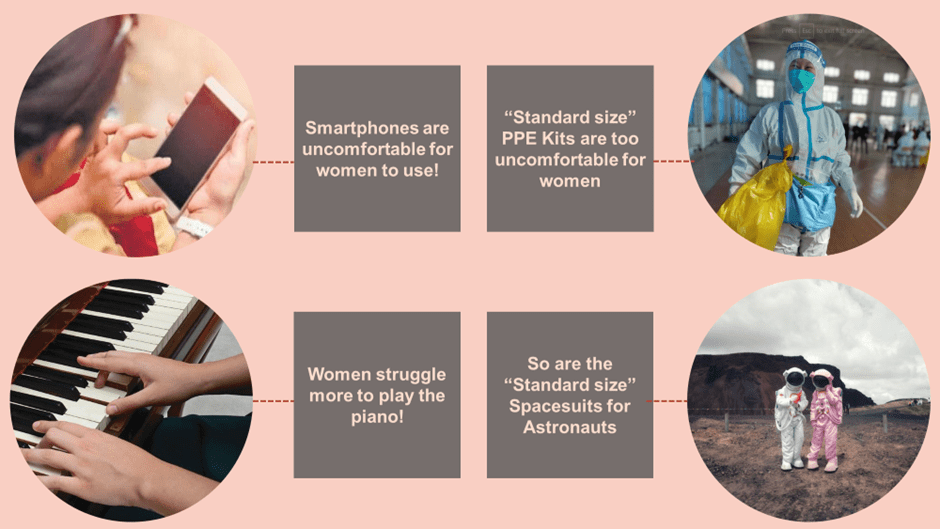
- Personal Protective Equipment (PPE) kits, masks and safety boots often fit men but are uncomfortable or unsafe for women.
- Medical and professional tools (like instruments, ergonomic devices) are designed for male hand sizes and grip strength, causing strain for female users.
- Smartphones and wearables commonly cater to male hand sizes, impairing usability and health monitoring accuracy for women.
- VR headsets, tested mostly on men, cause higher motion sickness rates among women due to differences in eye distance and processing.
- Piano keys sized for men’s hand spans contribute to fewer female pianists.
- Packaging and marketing enforce gender stereotypes: Use of pink or pastel colours for women versus dark or metallic for men. Language in marketing reinforces stereotypes, such as “soft” for women’s products and “powerful” for men’s. Scents and messaging often reflect traditional gender norms rather than actual consumer needs.
Men made public spaces and urban infrastructure based on their requirements, not of women
Cities and transportation systems have historically been created around the male norm, especially the model of the able-bodied male breadwinner. This meant that public spaces and transport are not geared for women –
- Sprawling suburbs and transport routes designed for men’s straightforward commuting patterns by car, which isolate women who rely on multi-stop trips by foot or public transit for caregiving, errands, and jobs.
- Poor lighting on streets, pedestrian underpasses, skywalks, and areas beneath flyovers, making these spaces unsafe or inaccessible for women, particularly after dark.
- Pavements and entrances that lack proper ramps or sufficient width, hindering access for wheelchairs, baby strollers, pregnant women, mothers with children, elderly individuals, and people with disabilities.
- A deficit of essential support facilities such as childcare canters, nursing rooms, secure public toilets, and adequate seating in parks and transit areas, which compromises the comfort and caregiving needs of women.

Enduring Impact of the Male-Norm Paradigm – The historical “by men, for men” structuring of work and infrastructure has entrenched systemic barriers for women, including:
- Wage inequality and glass ceilings limiting leadership roles
- Product and infrastructure designs that compromise women’s safety and usability
- Restricted mobility and participation in economic and civic life
- Underrepresentation and exclusion from decision-making processes
This not only perpetuates inequity but also hinders innovation, organizational growth, and societal progress.

Lessons from history for the “Future of Work”: Building a bias-free world
Learning from these deeply embedded patterns, building a bias-free future of work demands that we:
1. Recognize and Value All Forms of Work – We must redefine what constitutes valuable work. Unpaid labour—such as caregiving, household management, and community-building—should be recognized and supported at policy and institutional levels, not just seen as women’s obligations. Accurate data collection and representation of all forms of work are essential for truly inclusive policies.
2. Build Equity Into Policy and Practice – Every policy, program, or resource distribution mechanism must be consciously crafted to include women and other historically marginalized groups. This means proactive outreach, gender-sensitive design, and continuous impact assessments to root out inequities.
3. Ensure Equal Access to Assets and Resource- Inheritance laws, property rights, and access to finance must be reformed to allow women equal ownership and economic participation. Agricultural training, technology, and information services must be tailored to women as well as men.
4. Shape Inclusive Workplaces and Products- From product design to workplace policies, incorporating diverse perspectives ensures that outcomes serve everyone, not just a narrow segment with traditional power. Gender-balanced teams, inclusive leadership, and support systems (like parental leave for all genders) are critical building blocks.
5. Challenge and Change Social Norms – Institutional reforms must be accompanied by efforts to address deep-seated cultural attitudes about gender roles and work. Education, advocacy, and positive representation in media and leadership can shift mindsets over time.

Building a gender-bias-free future of work demands learning from historical patterns of exclusion and actively reversing them, embedding equity and intersectionality in policies and culture and redesigning workplaces, urban environments, products, and services using inclusive, evidence-based approaches. This is not only a moral and social imperative but also a strategic one to unleash innovation, resilience, and sustainable growth in a rapidly evolving global economy.
 Ellenomics