

Every year on March 8, the world observes International Women’s Day (IWD), a time to celebrate women’s achievements and advocate for gender equality. But beyond the celebrations, it is essential to understand the historical roots of this day, its continued relevance, and how it aligns with global commitments like the Beijing Declaration and the Sustainable Development Goals (SDGs).
The History of Women’s Day
International Women’s Day has its origins in the early 20th-century labor movements. The first National Woman’s Day was observed in the United States in 1909, inspired by the struggles of female garment workers for better pay and working conditions. The movement soon gained momentum globally, leading to the first International Women’s Day in 1911, marked by rallies in Austria, Denmark, Germany, and Switzerland. Over time, IWD became a platform to advocate for women’s rights, including voting rights, fair wages, and protection against discrimination.
In 1977, the United Nations officially recognized March 8th as International Women’s Day, further solidifying its importance in the global agenda for gender equality.

Women’s Day, the Beijing Declaration, and the SDGs
The Beijing Declaration and Platform for Action, adopted in 1995, remains one of the most comprehensive global blueprints for gender equality. It outlined critical areas requiring urgent action, including economic participation, education, health, and political representation.
The Sustainable Development Goals (SDGs), adopted in 2015, further reinforce the commitments of the Beijing Declaration. Goal 5 specifically focuses on achieving gender equality and empowering all women and girls. Women’s Day serves as an opportunity to assess progress on these commitments and push for accelerated action to meet the 2030 targets.
Why Women’s Day Still Matters Today
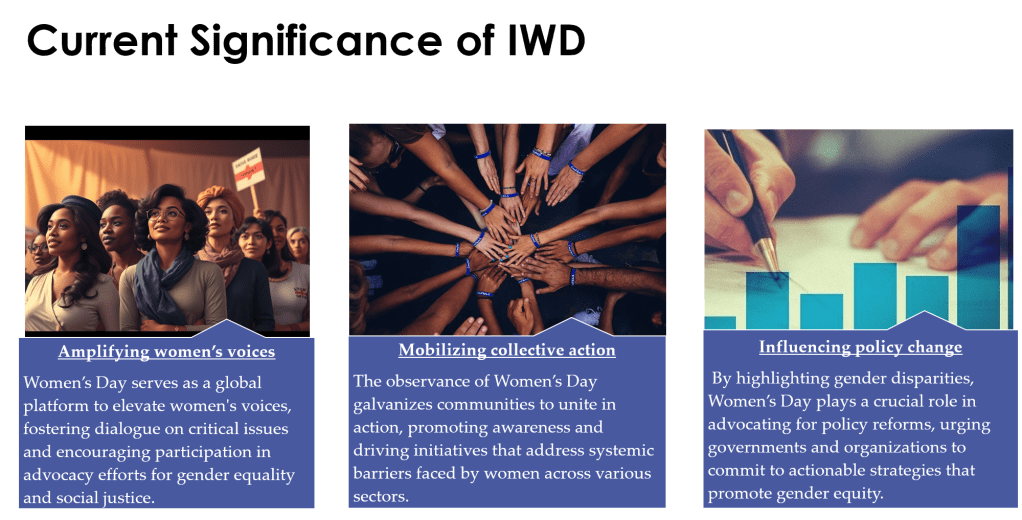
Despite significant progress, gender inequality persists in various forms—pay gaps, underrepresentation in leadership, gender-based violence, and barriers to education and healthcare. Women’s Day serves as a reminder that achieving true gender equality requires continuous effort, policy changes, and societal shifts. It is not just a day of celebration but also a call to action for governments, organizations, and individuals to work towards a more equitable world.
What Women’s Day Is NOT
Women’s Day is not merely a day for token gestures, social media posts, or corporate branding without meaningful change. It is not just about giving flowers or celebrating women superficially while ignoring deeper systemic issues. The day should not be reduced to a marketing opportunity but should instead be a moment for reflection, policy advocacy, and real commitments to gender equality.
Looking Ahead
As we commemorate Women’s Day, let us move beyond symbolic gestures and work towards real transformation. Whether through policy reforms, educational initiatives, or workplace changes, every effort counts in the collective journey toward gender equality.
Women’s Day is not just about recognizing how far we have come but also about acknowledging how far we still need to go. Let us use this day to commit to lasting change and a more equitable future for all.
 Ellenomics