

Vanshika Venkatraman
While working on this article I saw a crèche facility being built in my college campus. I walked past that construction site everyday but it wasn’t until I started on this article that I realised what it was. This real-time development reinforced my understanding of how institutions are adapting to support working mothers balance their responsibilities.
According to the Economic Survey 2024-25, India’s female labour force participation rate (FLFPR) increased to 41.7%, but is much lower than the global average of 47.8% and is driven mainly by the rising participation of rural women in unpaid own-account work. Working women in India face a “double burden” of raising their children alongside their day jobs. The recently released Time Use Survey, 2024, shows that Indian women spend 21% of their time on unpaid care and domestic work while men spend just 4%. As per PLFS 2021-22, 44.5% cited childcare/personal commitments in homemaking as reasons for not participating in the labour force.
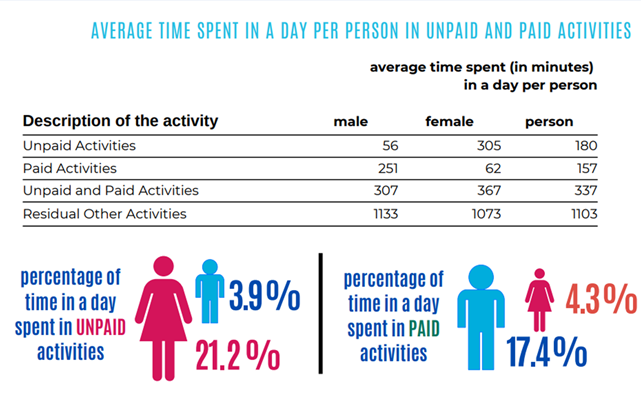
Therefore, to encourage greater female participation in the workforce, we need to develop a comprehensive care system in our country. This will empower women and support families while ensuring a more inclusive society. Essentially, we need to address three types of women’s unpaid care work – childcare, eldercare and burden of domestic chores.
With this background, this article assesses the current ecosystem of provision of childcare in India, which includes enabling government policies as well as the provision of public and private creche and daycare centres.

Access to regulated childcare allows parents, especially mothers, to participate in the workforce without worrying about their child’s safety and development. Well-regulated childcare services help reduce the burden of unpaid care work on women, promoting economic empowerment and career growth. Policies can mandate employer-supported childcare facilities or subsidies for working parents. Government regulations can ensure childcare services are affordable and available to all income groups, preventing socio-economic disparities. Special provisions can be made for children from vulnerable backgrounds, including single-parent households, low-income families, and children with disabilities.
In this context, following is a summary and implementation status of key laws and regulations governing childcare in India.
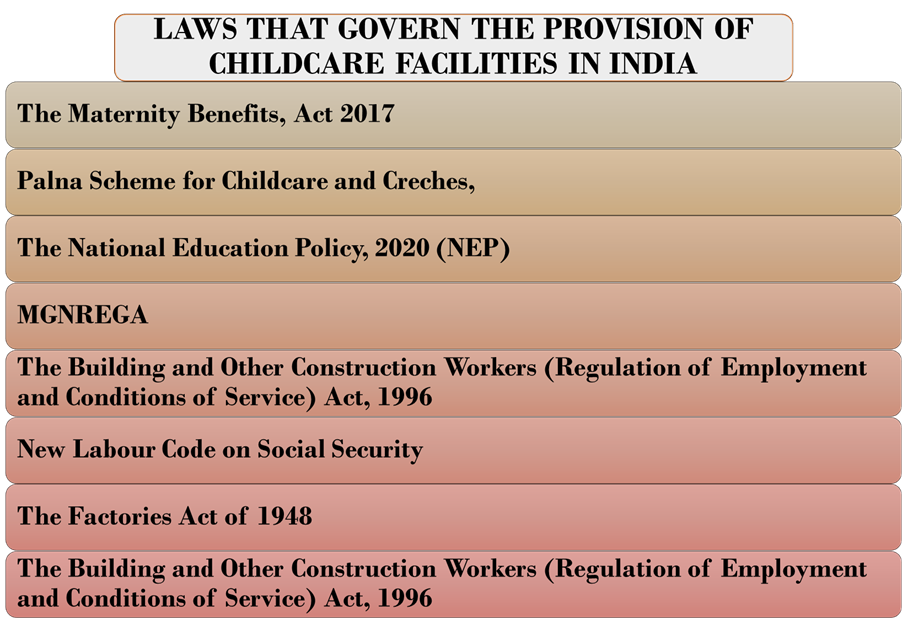
The Maternity Benefits Act, 2017
The Maternity Benefits Act, 2017 requires employers with 50 or more employees to provide crèche facilities close to their workplaces. The guidelines aim to help employers manage and select crèche facilities that meet minimum child welfare and sanitation standards.
The following are some key provisions in the national guidelines:
- The crèche must be located either at the workplace or in the employees’ neighbourhood, or within 500 metres of either location.
- Crèche facilities must accept up to 30 children — aged between six months and six years —and be available to all female employees regardless of their type of employment contract.
- A crèche’s opening time must align with the employer’s, and crèches should be open for between eight to 10 hours.
- Crèches must comply with minimum building standards and norms.
- Crèches should offer age-appropriate curricula and provide regular health checks and immunisation programs for children.
- Crèches must comply with minimum training criteria for crèche staff and minimum baby-to-staff ratio.
- Crèches must establish a monitoring committee that provides for parental representation.
Palna Scheme for Childcare and Creches
In 2006, the Rajiv Gandhi National Crèche Scheme (RGNCS) was launched by the Ministry of Women and Child Development to provide affordable childcare facilities to working mothers. RGNCS was renamed as the National Crèche Scheme in 2017, and implemented as a centrally sponsored scheme to provide daycare facilities to children of working mothers.
Recently, the Ministry of Women and Child Development issued guidelines for Mission Shakti, a proactive initiative designed to enhance women’s safety, security, and empowerment. As part of this effort, the former National Crèche Scheme has been reorganised and rebranded as the Palna Scheme, which now operates under the ‘Samarthya’ sub-scheme of the mission.
The Palna scheme aims to provide day-care facilities for children of working mothers and improve their nutrition as well as health. The scheme targets urban and rural working women who are employed for a minimum period of 15 days a month or 6 months in a year with children between the ages of 6 months and 6 years.
The scheme focuses on two types of crèches:
First, the “Anganwadi-cum-Crèches” which combine existing Anganwadis with crèche services to fulfil the requirements of both the mother and her children in one convenient location.
Secondly, the preexisting crèches that were running under NCS have been included as “Stand Alone Crèches”. These are open 7.5 hours a day and 26 days a month. Each crèche is required to provide:
- Holistic development of children
- A space tasked with providing quality nutrition, sleep, education and stimulation activities.
- A creche of 25 children should at least have one creche worker, helper and doctor.
The fees is between Rs. 100-200 per month per child, for regular families and subsided for families below poverty line who have to pay Rs 20, a month per child.
The program will be mostly funded by the central government (60%) but 30% of the funds are to be provided by the respective state governments and another 10% is to be funded by various NGOs.

The Creche Workers and Creche Helpers under Palna are honorary workers. There is no provision of salary or wages to the Creche Workers or Creche Helpers. However, the scheme guidelines have provision for grant of honorarium to Creche Workers and Creche Helpers. The amount of honorarium is governed through the type of Creche.

There is a huge variation in the implementation level of the creche schemes between States, with States like Karnataka and Kerela leading the way.

The National Education Policy 2020 (NEP)
The National Education Policy 2020 (NEP) was introduced to address India’s evolving developmental needs. It aims to overhaul the education system, including its regulation and governance, to align with the aspirational goals of 21st-century learning.
A key focus of the NEP is Early Childhood Care and Education (ECCE), recognizing that 85% of a child’s brain development occurs in the first six years. The policy adopts a comprehensive, play-based, and inquiry-driven approach to early learning, emphasizing flexibility and activity-based methods. For the first time, early childhood education is formally included from age three. The implementation of ECCE is a collaborative effort between the Ministries of Education (formerly HRD), Women and Child Development (WCD), Health and Family Welfare (HFW), and Tribal Affairs.
A major structural reform under NEP is the replacement of the 10+2 system with a 5+3+3+4 model, which integrates ECCE from age three to ensure a strong foundation for learning, development, and well-being. To expand and strengthen ECCE, the policy places significant emphasis on Anganwadis, which will now function as key early childhood education centers. ECCE will be delivered through:
- Standalone Anganwadis
- Anganwadis co-located with primary schools
- Pre-primary sections (ages 5-6) within existing primary schools
- Standalone pre-schools, all staffed with specially trained ECCE educators
For universal access to ECCE, Anganwadi Centres will be upgraded with high-quality infrastructure, play equipment, and well-trained educators. Each center will have well-ventilated, child-friendly spaces designed to foster an enriched learning environment. To ensure a seamless transition to primary school, Anganwadi children will participate in activity-based interactions with local schools, strengthening their readiness for formal education. Additionally, Anganwadis will be integrated into school complexes, encouraging collaboration between children, parents, and teachers across early and primary education levels.
By prioritizing early childhood education, the NEP 2020 lays the foundation for a stronger, more inclusive education system that nurtures lifelong learning from the earliest years.
Other laws that govern childcare facilities:
- Mahatma Gandhi National Rural Employment Guarantee Act (MGNREGA)– It legalises support for childcare in the unorganised sector, by including the provision for crèches. It recognises both the work-related rights of women, as well as their right to provide adequate nutrition and care for their infants.
- New Labour Code on Social Security– It requires the governments, NGOs or private entities to provide crèche facility located within the establishment or at an easily accessible distance for employees including a woman working from home.
- The Factories Act of 1948- As per The Factories Act of 1948, the employers of factories with more than 30 women workers shall maintain a suitable room or rooms for the use of children under the age of 6 years. Such rooms shall provide adequate accommodation, adequate light, and ventilation, maintained in a clean and hygienic condition, and shall be under the charge of women trained in the care of children and infants.
- The Building and Other Construction Workers (Regulation of Employment and Conditions of Service) Act, 1996- It requires a creche facility to be set up (on similar lines as the Factories Ac), if 50 female building workers are employed in a construction site.
State-Level Creche Schemes that Complement the Central Schemes
The Haryana State Creche Policy 2022 – Haryana is the first state in the country to come up with a creche policy. The Haryana State Creche policy mandates creche and day-care facilities, particularly for working mothers, in establishments with over 50 employees, focusing on quality childcare that includes nutritious meals, health check-ups, and early childhood development activities. Emphasizing a safe and inclusive environment, the policy sets infrastructure and staffing standards, provides training for caregivers in ECD, and includes government financial support through an annual budget and honorariums for creche workers, all to enable women’s workforce participation and ensure children’s healthy development. Children of working women from 6 months to 6 years will be able to stay in the crèche for 8 to 10 hours. The creche workers will be given Rs 15,000, helpers to get Rs 7,500
The Karnataka Government’s “Koosina Mane” – the program helps women who are part of the Mahatma Gandhi National Rural Employment Guarantee Act (MGNREGA) and other working mothers by offering assistance with childcare. Koosina mane means “child homes” or “creches.” Under the program, they will build child homes or creches in about 4,000 Gram Panchayats. These facilities offer healthcare, nutrition, and safety for children whose mothers work under the MGNREGA as well as for nearby working mothers.
Delhi Government’s SSK Chhava Centres – In the Budget 2021-22, Delhi Government announced an initiative called ‘Saheli Samanvay Kendras’ (SSKs). These SSK hubs serve as Convergence cum Facilitation Centre for Women and Girls. 500+ SSKs have been established by the Department of WCD in Delhi. Anganwadi Chaya Centres are envisaged to function as creche centres for children of working mothers as one of the four pillars of SSK. These centres shall function from 9.00 AM to 4.00 PM.
Maharashtra Shops and Establishments (Regulation of Employment and Conditions of Service) Act, 2017 – Section 23 of the Act requires that in every establishment wherein fifty or more workers are employed, there shall be provided and maintained a suitable room or rooms as crèche for the use of children of such workers. It also provides for a group of establishments to provide a common crèche within a radius of one kilometre.
Gujarat Shops and Establishments (Regulation of Employment and Conditions of Service) Act, 2019 – Section 21 of the Act requires that every shop or establishment wherein thirty or more women workers are employed shall provide and maintain a suitable room or rooms as creche for the use of children of such workers. A group of shops or establishments can provide a common creche within a radius of one kilometre.
Tamil Nadu’s State Industries Promotion Corporation of Tamil Nadu (SIPCOT) – SIPCOT has established crèches at several of its industrial parks.
Kerela’s Kudumbashree Mission – Kerala successfully piloted community-based crèches for working mothers in informal trades and self-help group enterprises.
NGOs and Non-Profits Providing Creches
Many NGOs and non-profit childcare providers are also enabling the provision of creche facilities for the informal and underserved population:
- Mobile Crèches, runs childcare facilities at construction sites, urban slums and industrial clusters in Delhi and NCR.
- Aveksha Day Care Centres in Telangana, a free creche facility for industrial workers, is an initiative of the Confederation of Women Entrepreneurs of India (COWE) and SIDBI (Small Industries Development Bank of India).
- SEWA Sangini Co-operative Childcare centres provide affordable care for informal women workers in Ahmedabad
Private preschools in the Formal Sector

Private preschools in India have grown significantly, especially in urban and semi-urban areas, with many operating under branded franchise models. These institutions offer structured early childhood education. However, the absence of a central regulatory body allows them to operate with autonomy in terms of fees, schedules, and teaching approaches. This makes accreditation and certification crucial factors for parents when selecting a preschool.
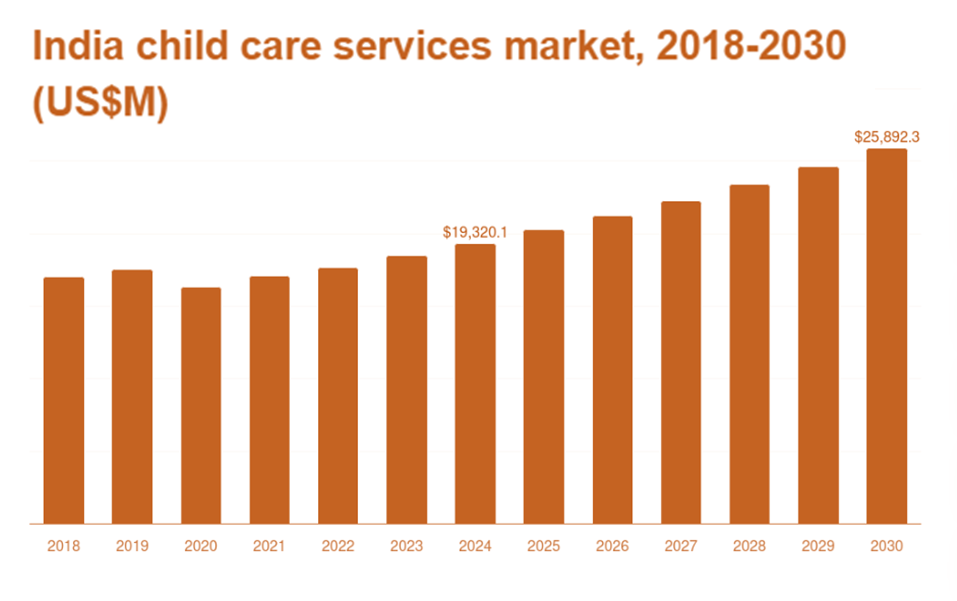
- The India child care services market generated a revenue of USD 19,320.1 million in 2024 and is expected to reach USD 25,892.3 million by 2030.
- The India market is expected to grow at a CAGR of 5% from 2025 to 2030.
While these laws and regulations have created the policy backing for developing creches and childcare centres, India needs stronger childcare guidelines to ensure safe, affordable, and high-quality early childhood care, enabling more women to participate in the workforce. Strengthened regulations will also promote child well-being, education, and equitable access to childcare across all socio-economic groups
 Ellenomics