
As we bid goodbye to Gen Z and Gen Alpha and welcome Gen Beta from 2025, I find myself reflecting on how the world seems to be growing more “masculine” in nature. The increasing dominance of capitalism, power dynamics, and violence continues to overshadow the global vision of inclusivity, empathy, and equal opportunities for all.
While 2023 offered hope for progress, 2024 was marked by escalating violence against women and the suppression of their hard-fought agency across spheres and geographies. With only five years left to achieve the Sustainable Development Goals (SDGs), SDG 5—focused on gender equality—remains the most off-track. Alarmingly, this year saw estimates that achieving gender parity would still take 5 Generations or 130+ years.
In India, there were visible signs of women’s growing economic and social empowerment, yet entrenched patriarchal norms and masculine dominance persist.
Here’s a review of the main highlights—both positive and negative—that for me defined 2024 from the perspective of progress in gender equality in India and around the world.
2024 Marked A Few Steps Back for Women in Leadership
Despite being a “super election” year, with 1.5 billion people voting across 50+ countries, 2024 saw disappointing progress for women in political leadership:
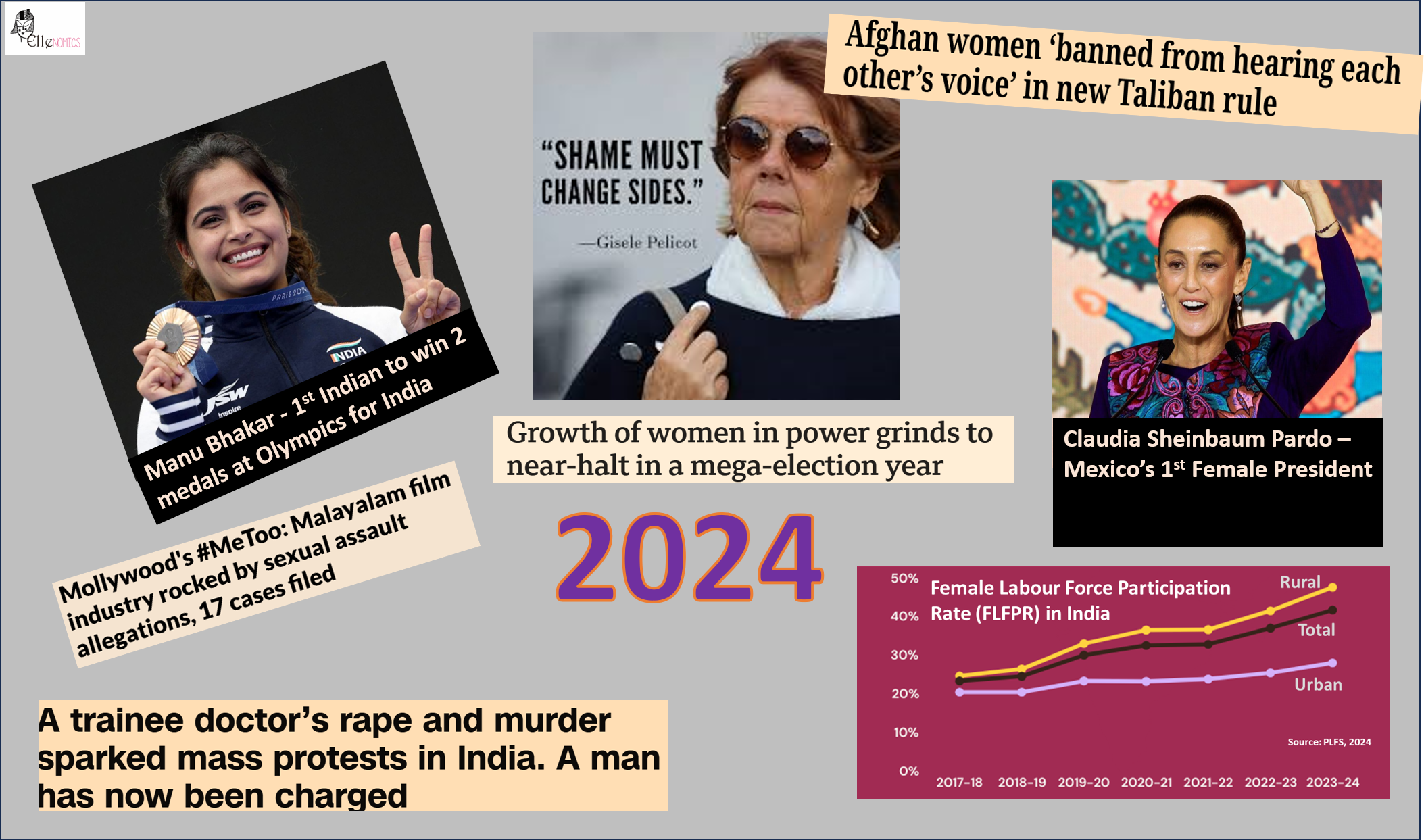
- Global female representation in parliaments rose marginally from 26.8% to 26.9%, with 27 new parliaments electing fewer women than before.
- Kamala Harris missed the opportunity to become the first female President of the U.S., while Donald Trump secured a second term despite felony convictions and several sexual harassment charges.
- On the positive front, gains included Mexico and Namibia electing their first female presidents and Sri Lanka achieving its highest-ever number of female MPs.
But what is concerning is that the general perception of people around the world shows growing, deep-seated prejudices where women are not seen as equally suitable to lead (see Reykjavík Index).

@antonioguterres on X
In India’s election results, despite the Women’s Reservation Bill being passed in 2023 to reserve 33% of seats for women – only 74 out of 545 or 13.6% of the elected representatives to the Lok Sabha are women (minimally higher than 11.9% before elections) (see more details here).


Growing Violence Against Women Was The Defining Theme of 2024
The year brought a disturbing surge in violence against women. In India, incidents such as the brutal rape and murder of a young doctor in Kolkata, systemic abuse in the Malayalam film industry, and the assault of two young girls in a Maharashtra nursery shocked the nation. Despite initiatives like West Bengal’s anti-rape Aparajita Bill and the Prime Minister’s call to expedite verdicts, gender-based violence failed to become a national priority.
Workplace harassment also persisted in India’s workplaces, with a 38% rise in reported sexual harassment cases in 2023–24 (Udaiti Foundation), and one in sixteen women reporting harassment in their careers (AON Voice of Women survey).
In Gaza, over 70% of verified casualties in the ongoing war were women and children, leaving survivors to cope with food, health, and emotional crises.

Gisèle Pelicot emerged as a symbol of courage and resilience. At 72, the French woman went public with her harrowing three-month-long rape trial, exposing the systemic abuse inflicted by her husband and others over nearly a decade. Her powerful statement, “Shame must change sides—from the victim to the perpetrator,” resonated globally.
Women’s Economic Empowerment Remained A Work in Progress
The 2024 South Asia Development Update by the World Bank found that raising female labor force participation rates in the region to those of men could increase regional incomes per capita by up to 51 percent.
However, the economic landscape for women in India showed mixed results:
- India’s female labor force participation rose to 41.7% in 2023–24, but the increase was driven largely by unpaid rural work. Salaried employment for women declined, and unemployment rose slightly (PLFS Report).
- Corporate diversity also stagnated, with women holding only 20% of India’s workforce roles and 18.4% of board director positions (CFA Institute).
- Women continue to face of workplace discrimination based on gender, age and marital status. They experience microaggressions and career setbacks, particularly after maternity leave (Aon).
- Even though there is progress in women’s autonomy and decision-making power in India, there is still a need to increase women’s control over their economic contributions (A report by IIM Ahmedabad’s Gender centre).
But Gender Equality Progressed in Sports
The Paris Olympics 2024 set a new benchmark for gender equality. Women continued to achieve laurels in sports. For the 1st time, the Games had a 50-50 representation of male and female athletes. More mothers competed than ever before. There was equal primetime coverage of men’s and women’s events.


The Year Showed that Women are Tired, Overworked and in Poor Health..
The death of Anna Sebastian, a 26-year-old Chartered Accountant, led to intense discussions about the workload of professionals in India and brought to the fore the fact that Indian women who have similar jobs work for the longest hours globally.
Unfortunately, a new research showed that while women reported more fatigue than men, they are perceived as significantly less fatigued than men! Analysis by the World Economic Forum showed that while women live longer than men, they spend 25% more of their lives in poorer health, grappling with a higher share of debilitating conditions, such as rheumatoid or osteoarthritis, atrial fibrillation or endometriosis.
And There Was A Growing Patriarchal Backlash…
2024 saw patriarchal forces strengthen across regions. In Iraq, controversial laws proposed lowering the legal marriage age for girls to nine. Afghanistan’s Taliban continued to impose bizarre restrictions on women. They banned women from midwifery and nursing courses and from praying loudly or reciting the Quran in front of other women, so that they cant hear each other’s voices. They also banned the construction of windows in residential buildings that overlook areas used by Afghan women.
Some Policy Developments Show Rays of Hope Amid Challenges
- India’s Gender Budget reached an all-time high, with Rs 3.27 lakh crore allocated for 2024–25—a significant 18.9% increase.
- The World Bank unveiled a gender strategy aiming to empower 300 million more women with broadband internet access by 2030, enhancing economic opportunities.
However, corporate DEI policies are waning, with The Economist noting “If 2020 was the year when diversity, equity and inclusion (dei) schemes ballooned and bosses declared their undying commitment, then 2024 marked the start of the anti-woke backlash. This pummelling will continue in 2025 and spread. “
What’s Still Missing? What’s Needed in 2025?
It is evident that mindset shifts are progressing too slowly, while backlash against women’s empowerment grows. As the The McKinsey-Lean In Workplace survey noted, while women have made gains over the past decade, many of their challenges remain unchanged—or have worsened.
In the face of lurking conflict and climate related crises, 2025 urgently needs greater feminisation of society and leadership
 Ellenomics