

By Tanya Rajesh
While women’s participation in parliaments across the world is at an all-time high, most parliaments continue to be male-dominated. Gender equality in parliaments is yet to be achieved, for the World and for India. Women are not a minority; they account for half the world’s population. Therefore, the power women hold in the parliament should be proportional to the population of women in society.
Active participation of women in electoral and parliamentary processes is crucial to sustaining democracy. Studies show higher numbers of women in parliament generally contribute to stronger attention to women’s issues. Electing female candidates facilitates women’s direct engagement in public decision-making. Women’s leadership in political spheres is shown to be socially beneficial according to a report by World Economic Forum in 2017. In addition, seeing women in positions of power also normalizes the idea and practice of women holding power.
According to a report by the World Bank women’s political leadership has been shown in a to have a prioritization of social issues, like health, education, parental leave, and pensions. Additionally, women’s political participation has been shown to be beneficial to women in their communities. Female voter turnout, female political participation, and the responsiveness of public services towards women are positively correlated with the presence of women in decision-making positions. Women in power also tend to prioritise women’s concerns and introduce more gender-sensitive laws.
Specifically for India, research shows that women legislators raise economic performance in their constituencies by about 1.8 percentage points per year more than male legislators. Another 2012 study showed that an increased proportion of women village leaders had closed the “aspiration gap” between girls and boys by nearly 25 percent and had eventually erased or reversed the gender gap in educational outcomes. Girls also began spending less time on household activities with increased women’s leadership in the village.
Therefore, one could argue that equal representation in parliaments is not only a matter of women’s right to equal opportunity and access but also an economic and development imperative.
IPU Parline publishes monthly rankings of the percentage of women in national parliaments. As of April 2024, India ranked 143 out of 183, with 14.7% of the speakers in the Lok Sabha being women. India is positioned behind several countries like Vietnam, the Philippines, Pakistan, and China. This highlights a severe issue of gender inequality in the Indian parliament. India’s percentage of female MP’s is far below the global average of 26.5%, and is below the South Asian average of 19% .
On 21 September 2023, Indian legislators passed the Women’s Reservation Bill, 2023. The bill passed both houses of Parliament (the Lok Sabha and Rajya Sabha) almost unanimously and will ensure that women occupy at least 33 per cent of the seats in state legislative assemblies and the Lok Sabha, the lower house of Parliament. India is not the first country to implement this law. Similar legislation has been enacted in 64 other countries. In 2003, Rwanda’s constitution set a 30% quota for women in elected positions, and now the country has women occupying 64% of parliamentary seats.
General Elections 2024 and Women in India
Women as voters
The voter turnout in the 2024 Elections showed that there was no gender gap as 65.8% of both men and women cast their vote. The participation of women in elections as voters has seen significant growth in recent years. The gender gap in voter turnout, which remained significant until 2004, has been steadily decreasing. In 2009, women’s turnout was 55.8% compared to 60.36% men. By the 2019 election, the female voter turnout was 67.18% and overtook the male voter turnout at 67.02%.
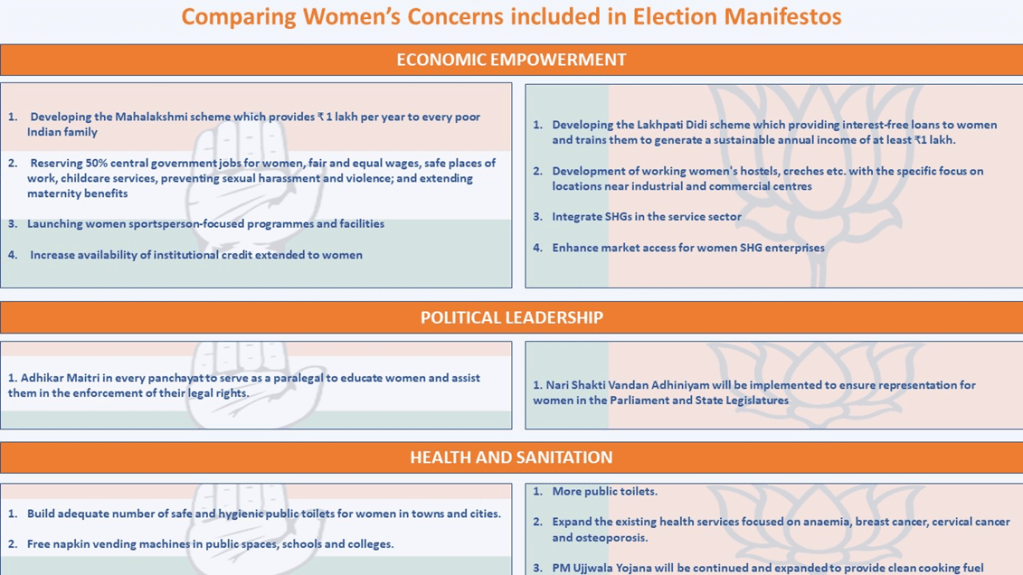
Women voters also played a very significant part in determining the results of the elections in 2019, which is why all parties paid special attention to addressing women in their 2024 campaigns. Figure 1 shows the key inclusions for women by the two largest National Parties – the ruling Bhartiya Janata Party (BJP) and the Indian National Congress (INC)
Women as candidates
A significantly large female voter base in recent elections still did not reflect in the performance of women candidates elected into the Indian Parliament. As has been the historical trend, there were very few female candidates participating in the elections. Female representation was severely lacking in the 2024 elections, as a total of 797 women stood as candidates, which was a mere 10% of the total number of candidates (8338). 28% of seats offered no choice for the electorate to choose a female candidate.
Women Elected to Parliament
Out of the 797 female candidates, India elected 74 women MPs to Lok Sabha, four fewer than in 2019. These 74 women make just 13.63% of the elected strength of the Lower House.
The notable point here is that while women made up 10% of candidates, women were 13.6% of the winners, indicating that women had a higher win percentage (9.3%) than male candidates (6.2%), showing that if parties nominate females, they have a higher chance of winning the seat!
Out of these 74 women, only 7 are women are included in the Prime Ministers Cabinet of 72 ministers, and out of them only 2 are cabinet rank, indicating a very minuscule representation of women in India’s political leadership.
Party-wise analysis
Analysing at the party level we find that BJP nominated the highest number of women at 69 (out of 440 Lok Sabha candidates), constituting 16 per cent. The Congress had 41 women out of 327 candidates, making up 13 per cent. 31 of BJP’s female candidates’ won (a success rate of 45%). In contrast, the Congress increased its tally of female winners from 6 in 2019 to 13 in 2024 (32% success rate). Regional parties DMK and JDU had a 100% success rate. TMC, with a 92% success rate, has the highest proportion of seats won by women (38%)

Concluding thoughts
There are numerous statistically backed reasons as to why India needs more women in political leadership. However, if Parliament does not mirror the increasing trend of increased participation of women in society, it sets itself up for a credibility crisis in the future. The government will find it tougher to take action to make India a better place for women. Given that the Women’s Reservation Bill is unlikely to be passed until the end of this decade, it is crucial to set the stage for the organic growth of women in political leadership. This will require women with political aspirations to come forward and be trained with the right skills and mindsets. Additionally, political parties must offer more tickets to women candidates, and all Indian citizens must cast unbiased votes for deserving female candidates in their constituencies.
 Ellenomics