

Sarah Abraham, B.A. Honours Economics (2024), LSR
Latest research published in The Lancet shows that India’s total fertility rate saw a significant decline from 6.18 in 1950 to 1.91 in 2021, and may further drop to 1.3 by 2050 and 1.04 by 2100. The study reveals that India recorded more than 1.6 crore live births in 1950, which rose to 2.24 crore in 2021, but is expected to plummet to 1.3 crore by 2050, and further to 0.3 crore in 2100. While this may seem like good news for the country with the largest population, the plummeting fertility rate may result in an ageing population, and create face labour shortages in the long run: which unfortunately means India may likely get old before it becomes rich.
In this article, we look at how India can learn lessons from some other countries to help maintain its birth rate above the replacement rates, so that it can continue to reap the benefits of its demographic dividend.
Women’s fertility has always been a question of great importance because it is the prime determinant of the growth and survival of humanity. Back in the day, a woman’s sole job was to bear children. And not just any at that, women were to specifically bear male children. If the child wasn’t male, women were forced to try till they birthed a son. This traditional social structure majorly confined women to the cycle of childbearing and rearing – a cycle that women have been eager to break out of!
The fertility rate can be used to trace the outline of the growing population of the world. One of the simplest forms of understanding fertility across the globe would be the Total Fertility Rate. Defined as the total number of children that would be born to each woman if she were to live to the end of her childbearing years. It is currently believed that the most ideal fertility rate is the replacement rate. The replacement rate, which is pegged at 2.1 (National Institute of Health (NIH)) can be defined as ‘the level of fertility which helps the population exactly replace itself from one generation to another’. However, this ideal fertility level has become a far-fetched dream for some economies
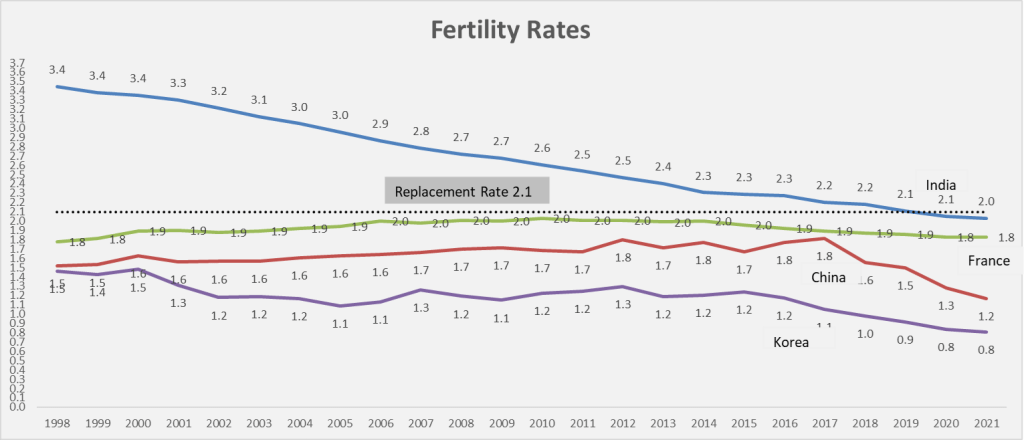
China is an example of a country where the fertility rate has fallen below the replacement level. The government intervention in 1980s led to 35 years of a strict child policy enforced upon its people. The main aim of the policy was to reduce the rapidly expanding population of the country. However, its regimented One Child policy has left the country with an even bigger problem- one of an aging population. This government intervention is ironically called a “Government Birth Control”, a situation where the government dictates the reproductive decisions of its people. The Chinese government is focusing on reducing abortions which has seen skyrocketing rates. In addition to this, the government aims on expanding IVF treatments which were available to only married women to include single women as well.
The fertility rate in South Korea has also been on a continuous decline with it hitting its lowest in 2023. With the fertility rate falling below 1, South Korea is now the country with the lowest fertility rate. Comparing the replacement rate to the fertility rate of South Korea which stands at 0.78, it is no wonder that the devastatingly low fertility level is a cause for concern. One of the reasons for this fall in fertility is an increase in female literacy and employment. Children in Korea are very rarely born out of wedlock, with an increase in women’s education, a social change has taken place in Korea where women prefer to delay marriage to work. Marriages are also on the decline in South Korea due to the rising cost of housing and real estate. An increasing number of couples are also gravitating towards a child-less marriage, giving rise to a new term – DINK. Double Income No Kids. Policies targeting fertility in South Korea can be categorized into cash, in-kind, vouchers and service policy which range from infertility services to allowances for diapers and formula to low income families. However, the country still faces problems with parents, especially fathers refusing to avail benefits such as parental leave. Korea’s work culture can be blamed for this. Long working hours and a general air of disdain towards absences from work has led to very few couples availing services such as parental leave.
Another country on the list of low fertility rates is France. With many referring to the issue as the “Baby Bust” or “To Bebe Or Not To Bebe”, France has recently witnessed the lowest levels of births since the second world war. This is surprising as among its fellow European comparators, France has historically avoided a baby crisis and has been successful in maintaining a significantly high fertility rate. One of the newer reasons for the decline in the fertility rates has been due to the growing infertility among couples. A 2022 report published in France reveals that up to 14% of couples in France have faced some form of infertility. To combat this problem president Macron intends to launch free fertility testing for women aged 25. This decision has however been met with widespread criticism. Many feel that pressurising women aged 25 to think about childbirth in a country where the average age at first birth is 31 years is quite bizarre. In addition to this France also aims to improve their parental leave by increasing the payouts under the scheme. Another policy that the government wishes to implement is government assistance in medical procedures such as IVF. These policies are yet to be formalized and integrated into the French economy.
Shifting our gaze towards the situation in India, we find ourselves on the cusp of a window of opportunity. However, with India’s fertility rate falling below the replacement level, the baby boom is now a phenomena of the past. Like the other countries, a major reason for this fertility reduction is the improved status of women in the economy, with increased access to education for women and modern contraceptives. Unlike China which has an alarming number of elderly population, the demography of India is dominated by the youth who find themselves at the brink of their reproductive years. Hence, India is not expected to see a fall in reproduction rates for the next 30-40 years.
However, to avoid falling into this trap of low fertility rate, India must take a page out of history and learn from the shortcomings of countries like China, Korea and Finance. The government and policymakers could, therefore, consider the following actions –
- Incentivise employees to take “time off” from work, and promote a work culture that helps people balance their work and family commitments. Leaders and policymakers need to build an ecosystem where people, especially women, are not penalised for taking time off or seeking flexibilities
- Mandate paternal and/or family leave policies, to create a mindset where fathers can be equal caregivers and the burden of childcare doesn’t fall exclusively on women. Also, create and build a strong caregiving ecosystem of daycares and creches where men and women can leave their children while continuing to pursue their professional aspirations. These steps would go a long way in incentivising women to continue to have children even while building their careers.
- Focus on women’s health issues, and pay greater attention be infertility issues among both men and women. Government policies targeting infertility must be implemented and made accessible and affordable.
- Crackdown on illegal and forced abortion related to gender-based infanticide
- Improve the nutrition and health of children and promote vaccination to increase the survival rate in babies and children
 Ellenomics